Islamicart


Abstract
This is the first abstract painting I have done, and I’ll write some ayat on this particular piece. Abstracts fill in your white page and gives a colorful reflect.
I don’t have any idea about any particular method to do abstract painting, what I did was I pour White colour first on the paper, and added some yellow to it, spread it vertically on the paper with the help of back side of a fork (hehe I don’t have proper tools yet :D) followed by white and red giving a pink look, and then some blue . Spread them all in a vertical position.
Though it may be having mistakes or incorrect procedure but I’m kinda satisfied with the result.
Have a happy reading, hope it will be helpful 🙂

Qalam (pen)
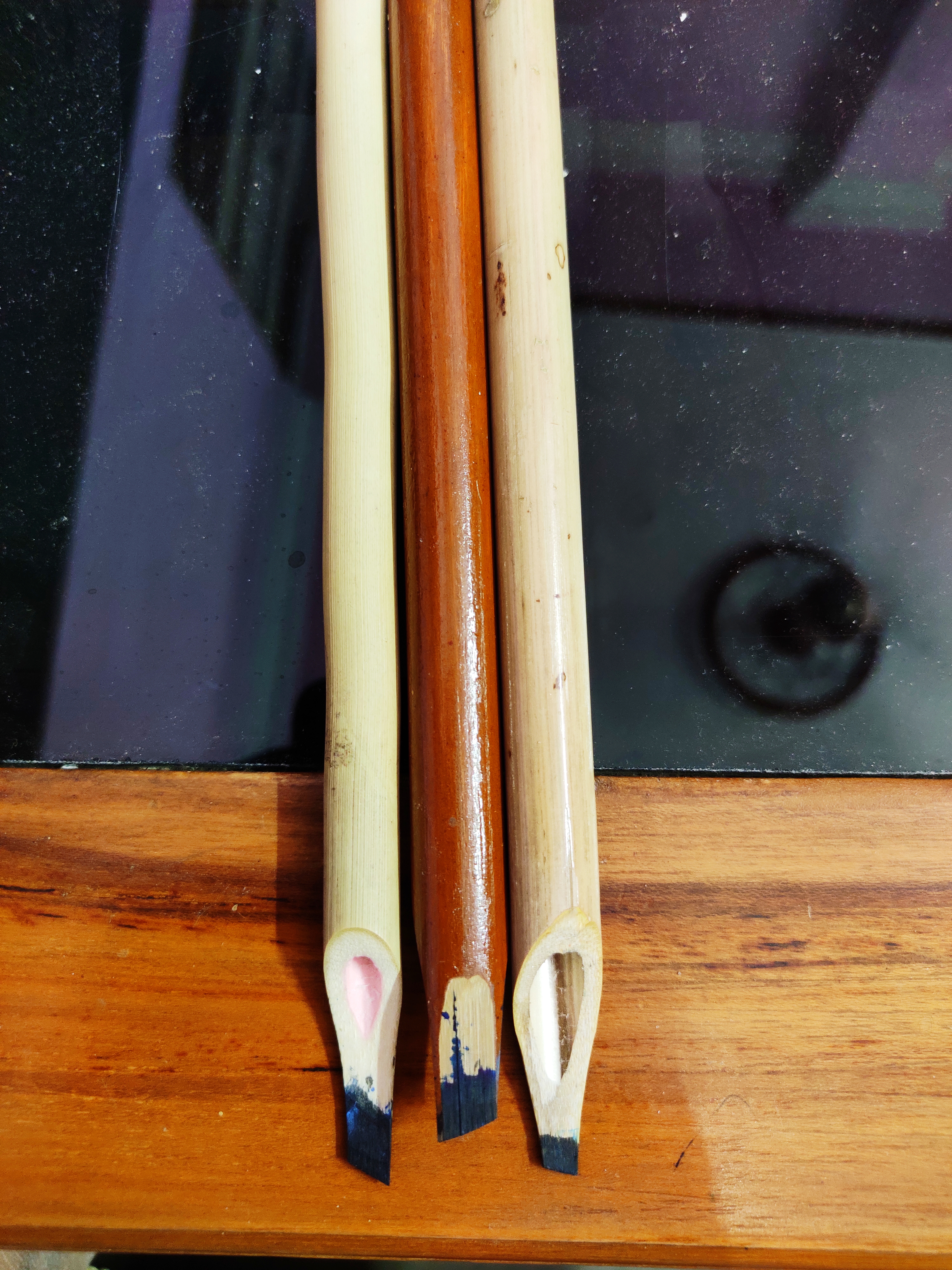
In order to do Arabic calligraphy, there is a special tool used known as Qalam. This is the most important tool to look after and taken care of, if this Qalam isn’t carved from the correct angle, then the word formation won’t be perfect
There is a whole process of qalam carving:
A normal bamboo can be used to make a Qalam though a variety of woods are used for the same. But as a beginner, a normal bamboo stick will work.
Take a dry bamboo stick of 10-12 cm or as long/ short as you prefer or feel comfortable with. Use a knife or a cutter(thick blade) to carve the stick from any end if it doesn’t have any knot. The carving should be in a curve pattern. Initially, make small cuts from 1.5 inches of the stick using your thumb to control the knife. Do not rush, be polite with the wood and don’t apply too much pressure cuz it may damage your qalam, slowly and steadily , keep on making cuts on wood until you see the inner portion of the bamboo, try to maintain a balance on each side, shave the excess edge gently and giving the tip a flat and sharp shape.
Turn your bamboo around and shave it a lil to make the tip or nib more flat. Be patient and gentle, a wrong cut may damage the Qalam. Now let’s move towards the last part , giving qalam a nice and perfect cut, put the Qalam on some tough surface facing the carved portion towards you and the back portion touching the surface and make a cut between 85°-75°. Now smooth out the nib by rubbing it gently against sand paper( be extremely gentle) and you are ready to go.
Your Qalam is ready to run on paper.
Enjoy!!

Khat e Deewani
Diwani is a calligraphic variety of Arabic script, a cursive style developed during the reign of the early Ottoman Turks (16th century – early 17th century). It reached its height of popularity under Süleyman I the Magnificent (1520–1566).
It was labeled the Diwani script because it was used in the Ottoman diwan and was one of the secrets of the sultan’s palace. The rules of this script were not known to everyone, but confined to its masters and a few bright students. It was used in the writing of all royal decrees, endowments, and resolutions. A Diwani text adorned with a tugrah, a complex calligraphic seal, represented the authority of the Sultan and the Ottoman state.
The Diwani script can be divided into two types:
The Riq`a Diwani style, which is devoid of any decorations and whose lines are straight, except for the lower parts of the letters.
The Jeli Diwani or clear style. This kind of handwriting is distinguished by the intertwining of its letters and its straight lines from top to bottom. It is punctuated and decorated to appear as one piece. The Diwani handwriting is known for the intertwining of its letters, which makes it very difficult to read or write, and difficult to forge.
Diwani is marked by beauty and harmony, and accurate small samples are considered more beautiful than larger ones. It is still used in the correspondence of kings, princes, presidents, and in ceremonies and greeting cards. and has a high artistic value.
 khushnawees